
There are several reasons why people choose to render their homes. It provides a decorative finish that can really brighten up tired houses, especially those with damaged brickwork or existing discoloured render. It is also the final stage of external wall insulation.
When it comes to knowing which render to choose, all the terminology can be a bit baffling. What’s the difference between different types, and how much do they cost? We have looked at costs across the country for different types of rendering system. Below, we talk you through the options, from the highest cost to the lowest, with an introduction of how render types differ.
Rather than just giving example costs for different types of material, we thought it would make sense to give rough costs for different part of the country, as installation costs tend to be more expensive the further south the property.
[button_page_link title=”Why render your home?” url=” https://www.thegreenage.co.uk/render-house/” image=”https://www.thegreenage.co.uk/wp-content/uploads/2013/04/Solid-Wall-insulation-white-render-finish-780×350.jpg” button_text=”Read more”][/button_page_link]
Before we start, we should say that we’re basing our estimates on these average sizes:
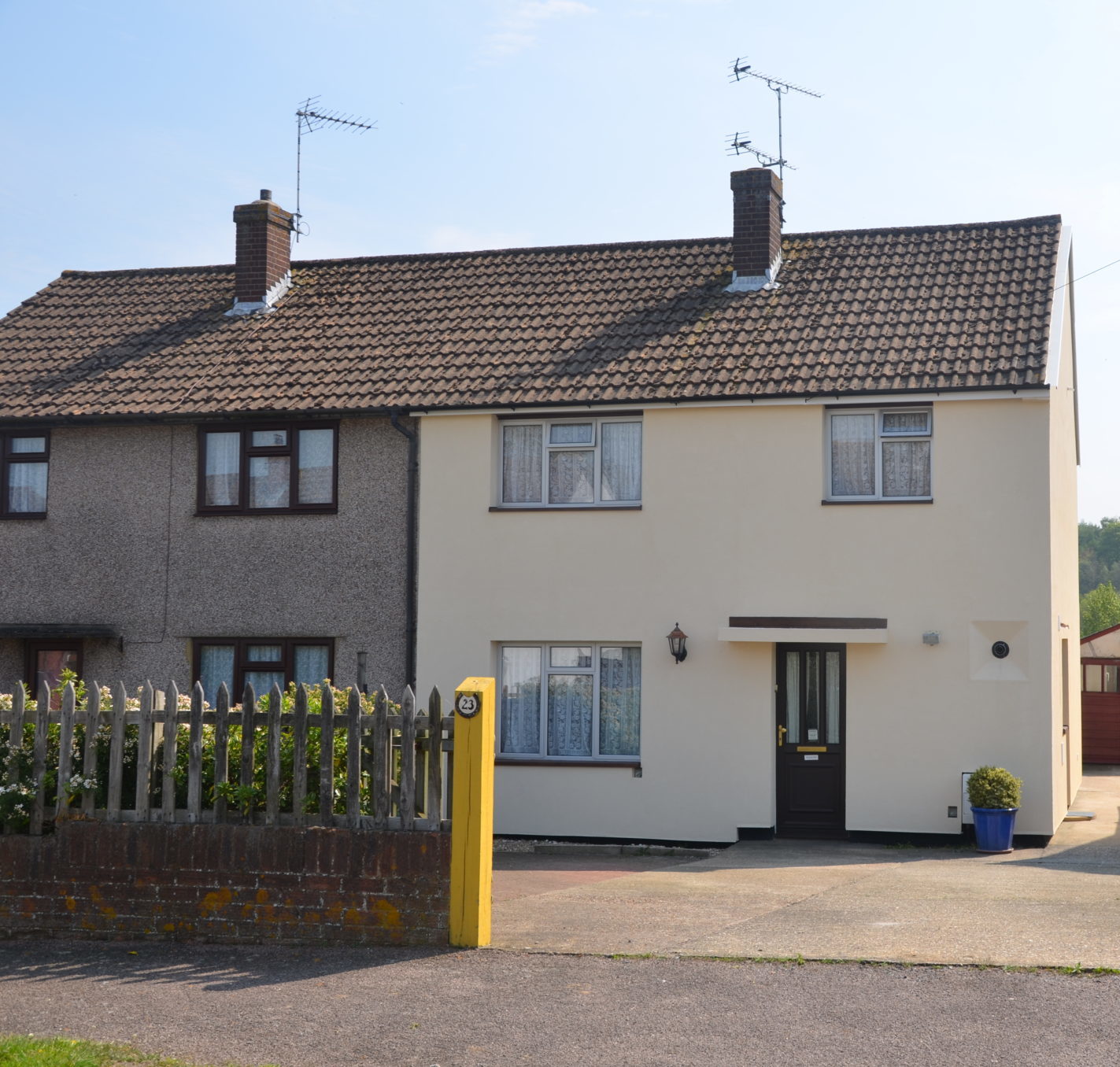
Small mid-terrace house = 40-50m2
Large mid-terrace house = 70-170m2
3 bed semi-detached = 110-160m2
3 bed detached = 110-160m2
4-5 bed detached = 180m2+
To get an idea of costs, multiply the price per square meter of the property type you are looking to render by the cost of installation in your area of your chosen type of render. These are listed below:
External wall insulation
| South | £100-150 per m2 |
| Midlands | £85-130 per m2 |
| North | £80-120 per m2 |
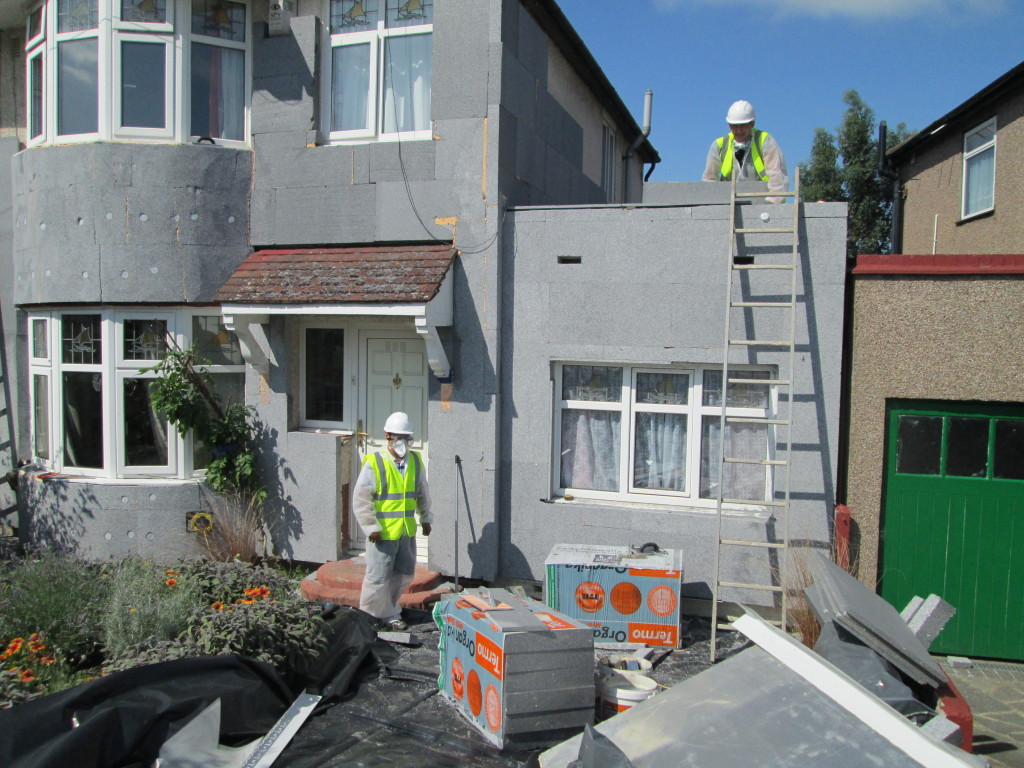
External wall insulation means fixing solid insulation boards to the outside of a property, before finishing with primer and a thin-coat acrylic or silicone render. The final price depends on the exact system you choose, but it will be roughly twice as much as coloured render, as there is much more work and more materials required. However, render and EWI should not really be compared like-for-like, as they offer completely different solutions. Render can lift the appearance of your property, and protect its walls, but it does not improve its thermal performance. While render is cheaper, external wall insulation will save you money on your heating bills in the long run.
Silicone or acrylic thin-coat render
| South | £60-75 per m2 |
| Midlands | £50-60 per m2 |
| North | £45-60 per m2 |
(Silicone render is more expensive than acrylic render, by £1-2 per m2)
Silicone and acrylic renders are the newest and best-performing type of render. They are more expensive because they are flexible, meaning they will move with the building and not crack. Also, silicone stays cleaner for longer so it will keep your render looking new. If you’re going down the render-only route, it’s probably worth spending a little extra money in the first place for a finish that will stand the test of time. Check out ‘Coloured Render cost per m2’ by EWI Store for more information about the components of these render systems.
Monocouche/colour render
| South | £50-70 per m2 |
| Midlands | £35-55 per m2 |
| North | £35-50 per m2 |
Modern through-coloured render provides a decorative, weather-proof finish for external walls. Unlike render covered with paint, it does not show scratches and therefore stays looking newer for longer.
Some systems have mesh sunk into the render around doors and windows to give them extra strength. Fully-meshed systems give extra strength and impact resistance, but will cost around £2-5 extra per m2. What goes into the Monocouche render system? Our friends over at EWI Store have written a blog all about the different components and how much they cost.
Sand and cement render
| South | £35-45 per m2 |
| Midlands | £25-35 per m2 |
| North | £20-30 per m2 |
This is a traditional type of render that has been around for years. Although on paper it’s cheaper than newer render types, there’s a false economy at play; because the sand and cement render will need to be painted after installation, it will probably end up costing the same overall as coloured render systems. Bearing this in mind, it may be wise to opt for a newer render type, which gives a higher performing finish.
Additional costs to bear in mind
We have not included the following extra costs in our calculations, because they vary so much from job to job:
[list_circle]
- Scaffolding
- Priming
- Removing and disposing of old render (if applicable)
- Beading around windows and doors – the more windows and doors, the more the job will cost, so a plain wall could cost less than one with lots of windows, even if the square meterage is bigger.
[/list_circle]
Installing render or solid wall insulation?
Interested in getting solid wall installation? We have scoured the country for the best tradespeople, so that we can make sure we only recommend those we really trust.

If you would like us to find you a local installer, just fill in the form below and we will be in touch shortly!
Think we missed something? Do you have a different opinion?
Comment below to get your voice heard…





Do these prices include the cost of materials?
Hi, we are about to do render our house and received two quotes one for acrylic render and one for monocouche render. I have no idea what is considered the better product and would appreciate some advise.
[…] Render can have similar issues with cracking as above, but is utilised to offer a layer of protection to the underlying stonework. This was traditionally used where unfinished structural stonework was rougher/ cosmetically poor, or in exposed areas – coastal etc. Breathable lime-based renders were used on older buildings, and replacement with concrete can cause damp issues. Newer buildings have concrete render, which will usually last about 20 years. Certain areas of the country (in my experience Cornwall particularly) have issues with render staining which requires cleaning (15). Budget a couple of thousand pounds, plus VAT and scaffolding costs for a re-render (16, 17). […]
On the earlier basement render question – would it be better to put additional corner beads to the metal beads already in place for sand/cement rough render, put base coat on top and mesh on top of the sand cement render, then apply primer and silicone top coat? Will this provide a more lasting better quality low maintenance silicone render? Also, how long must one wait after applying the base coast & mesh before applying primer?
I have basement stair and light well external walls with Newton Damp proof system mesh on the concrete substrate. The wall area is 40 m2 Over the mesh is a cement / Devon sand mix rough render. This has been on for about 2 years. I want it finished with silicone render like K-rend. Would it be OK to put base coat where necessary on top of the cement/sand render where it is very rough or over the small area where the render has come off the mesh, then apply primer and top coat? Is brilliant white a good choice as opposed to say light grey or off white to allow more natural light on a dull cloudy day?
I am looking to do render on top of render. Long story short, I had Krend installed on my property 3 years ago and while the product was fine the builders did an absolute botch job. Do you know if I can paint acrylic render straight on top?
Hi Jonno, you can’t paint acrylic render on top unfortunately. Acrylic render is something we would not recommend full stop to be honest, we would always recommend a Silicone or Mineral based render. Acrylic doesn’t allow any moisture to travel through it, so if there is moisture in the wall behind it, this will result in bubbling.
For all the renders thought, first you need to but a new basecoat layer on to provide a nice flat surface (this is also reinforced with fibreglass mesh so no cracking!). Then on top of this, you add the new thin coat render.
NO…… the whole wall will need to be primed again and then re-finished. why no just paint it