
What is a biomass boiler?
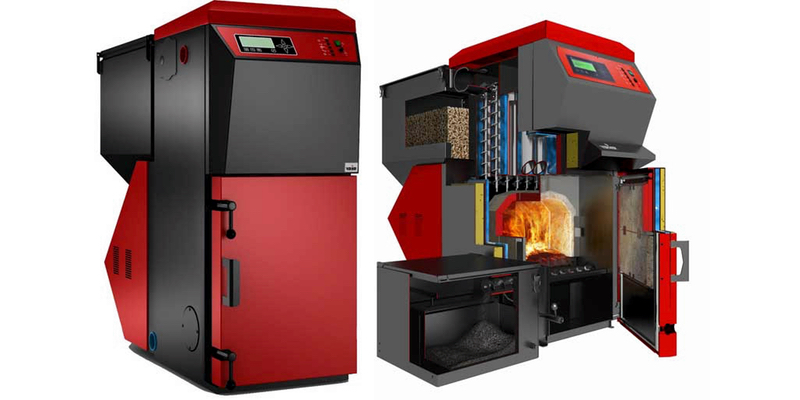
Biomass boilers are very similar to conventional gas boilers that you will be familiar with, providing you with space heating and hot water for the entire home, but instead of using gas (or oil) to produce the heat, they combust sustainably sourced wood pellets.
Using wood in place of fossil fuels helps to prevent long-term climate change, since the carbon dioxide released during the combustion was actually absorbed while the tree was growing, so they are essentially carbon neutral.
Each year, approximately 8.5 million tonnes of wood goes into landfill in the UK; this waste wood could be used in either biomass boilers (if converted into the pellets) or burned in wood burning stoves. This would not only provide heat and hot water, but in doing so, it would also ease the pressure on landfill capacity.

How does a biomass boiler work?
A biomass boiler works in a very similar way to conventional boilers, combusting fuel to produce heat that is then used to heat water. Biomass boilers are normally substantially bigger than their fossil fuel-burning brothers though, for a number of reasons. Firstly since they are burning wood pellets as opposed to gas, the boiler needs to be larger to hold the larger volume of fuel.
In addition, you may wish to install an automatic feed hopper on your biomass boiler, which will require additional room. This hopper stores a large volume of the wood pellets that are then automatically fed into the boiler as required, meaning that the boiler needs to be refuelled very infrequently.
It is also a good idea to have a store of the wood pellets at your property so you can keep producing heat if for some reason there is an issue with your fuel supplier. Ideally this should be close to where the fuel is delivered to your home, to minimise the distance you have to carry it.
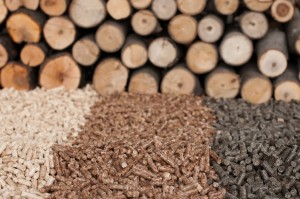
Most residential biomass boilers can also run on logs as well as the wood chips, so if these are in plentiful supply or if you can source them cheaply or even for free, it will dramatically reduce the operational running cost of your biomass boiler.
Every four weeks or so, the biomass boiler will need to be emptied of the ash. This can be put straight onto a compost heap to help fertilise the soil.
Biomass boilers are designed to work all year round; however you may choose to turn them off in the summer. They can be coupled with solar heating or an electric shower, providing you with your hot water for washing only, during the warmer summer months.
How does biomass measure up against traditional fuels?
Biomass boilers measure up very favourably in terms of running costs vs. natural gas, heating oil and especially electricity. The numbers can all be seen in the table below.
Figures courtesy of Biomass Energy Centre
| Fuel Type | Price per Unit | kWh per unit | Pence per kWh |
|---|---|---|---|
| Wood Chips | £100 / tonne | 3,500kWh / tonne | 2.9p / kWh |
| Wood Pellets | £200 / tonne | 4,800kWh / tonne | 4.2p / kWh |
| Natural Gas | 4.8p / kWh | 1 | 4.8p / kWh |
| Heating oil | 60p / litre | 10kWh / litre | 6.0p / kWh |
| Electricity | 14.5p / kWh | 1 | 13.4p / kWh |
Standalone boilers
A biomass boiler might simply be too big for your home, but smaller standalone wood burning stoves are also available, which are normally used to heat one room by burning logs or waste wood. These wood burning stoves can be fitted with a back boiler that uses the heat produced when the wood is combusted to heat water, that can then be used for either space heating elsewhere in the home or for hot water only.
Both standalone wood burning stoves and biomass boilers will need a vent, designed specifically for wood fuel appliances, with sufficient air movement for proper operation of the stove. Your existing chimney can be fitted with a lined flue, which is relatively inexpensive.
Can I get a free biomass boiler?
Under the Domestic Renewable Heat Incentive scheme, you will be eligible for payments towards the cost of installing the technology. These are quarterly, and over seven years, so you will still have to find the money to cover the upfront costs. How much funding you will receive depends on how energy efficient your home was before you installed your biomass boiler. You will start by having an EPC survey, and then payment rates are calculated by multiplying the ‘heat demand figure’ on your report by the current rate for biomass boilers. This means that some models will eventually be paid for fully by RHI payments, but many – especially top-end models – will not be covered completely. Find more information here.
Remember a carbon monoxide detector
It is really important when burning any type of hydrocarbon fuel (natural gas, coal, biomass) that you install a carbon monoxide detector in your home. In theory if all the fuel is 100% burned you produce heat, water and carbon dioxide, but in reality not all of the fuel burns. This means sometimes harmful gases like carbon monoxide can be emitted, which can be deadly. As long as you have a working carbon monoxide detector, you will be able to make full use of all the benefits a biomass boiler can bring.
Benefits
[list_circle]
- Biomass fuels are considered a renewable fuel – the carbon dioxide they produce when they are burnt is offset by the carbon dioxide they absorb while they are growing. Savings in carbon dioxide emissions are significant – up to 9.5 tonnes per year when a wood boiler replaces a solid (coal) fired system or electric storage heating.
- Fuel savings are less significant, and if you replace a gas heating system with a wood burning system you may end up paying more for your fuel. But if you replace solid fuel or electric heating with the cheapest biomass fuel you could save between £170 and £390 per year. Typically, heating and hot water costs for a year will be around £1,000 in a detached property.
- If you have a ready supply of logs at home you can effectively heat your home for free.
[/list_circle]
Limitations
[list_circle]
- There are increased maintenance requirements with this technology; for instance the wood pellets must be loaded on a regular basis to ensure it continues to provide energy. In addition, the ash bins need to be emptied from time to time.
- You will need storage space to store the fuel at your home.
- Wood costs often depend on the distance from your home to a wood supplier and whether you can buy and store wood in large quantities. If you have your own supply of wood fuel then this can significantly reduce your costs.
[/list_circle]
Cost
[list_circle]
- A standalone pellet stove may cost about £4,300 including installation; however for an automatically fed pellet boiler the cost is considerably higher at about £11,500.
- A wood burner will cost anywhere between £500 and £3,000 depending on the size and style.
[/list_circle]
Installing a biomass boiler
Are you thinking about installing a biomass boiler? We have scoured the country for the best tradespeople, so that we can make sure we only recommend those we really trust.
If you would like us to find you a local installer, just fill in the form below and we will be in touch shortly!




We are a business in Morpeth, Northumberland and are considering a new bio mass boiler ?
Could you send me details of someone who could advise please ?
Regards
Dean Hogarty
Dear Sirs,
We take this opprtunity to introduce ourselves as an Industrial processing Engineering company based in Montreal,Canada.
We have one customer who’s looking for the following:
1- Biomass wood burner 50 000 000 millions BTU per hour.
2- Dry large amounts of woodchips. The continuous flow biomass dryer should be able to dry large quantities of woodchips in a small time.
3- production speed with a biomass hot air generator at continuous flow biomass dryer connected to a 500kW (50,000,000 BTU/hr) hot air generator
4- flow biomass dryer can dry 40 to 50 cubic meters of woodchips from 55% to 5% moisture content. During that hour, the hot air generators will use 1.4 cubic meters of woodchips as fuel.
5- Example:This means that 14.1 tons of green wood will be converted to 7.0 tons of wood with 5% moisture content per hour
Please quote your best price as soon as possible.
Kind regards
CHARLES JAWDE | charles@trustech.ca
Tel. 514 316.0400 | Cell. 514 378.9889
4867 rue Levy, St-Laurent, QC H4R 2P9
omg biomass is so good like literally it keeps my house soooo warmmmmmmmmmmmmm om ahhhh i love it
omg biomass is so good like literally it keeps my house soooo warmmmmmmmmmmmmm om ahhhh i love it
I cannot find anyone to service/repair my biomass pellet boiler in my area East Yorkshire. I would appreciate any help.
well lad drop the post code and ill be over in 2 mins x
gwan lad get stuck in
i want some new boilers for my elderly mother
im looking for some brickwork and blockwork
I need a 40kw woodpellet boiler
Please could you answer the following:
How do the elderly infirm or disabled manage one of these boilers. I would not want to be emptying ash every few weeks nor putting logs on.
What is the cost of one of these boilers?
/
Product brochure pleaSe
We need a log boiler for our new house under construction
My wife and I have been living abroad for a number of years but we have a property in rural Essex that is currently heated on oil. I have been reading about grants available for heating and was looking at the possibility of installing a Grant Boimass boiler as I heard they are the best. The tenants that occupy my property have a disabled child – would we qualify for any grant or can we get the RHI? I am not fussed really as I know these systems will payback at some point, so I can afford to pay for it. Many thanks