Absolutely, Here’s What You Need to Know…
When most people think about making their home more energy efficient, adding insulation, switching to a heat pump, installing solar panels they tend to focus on the what. What measures are available? What government grants can I get? What will it cost my energy bills?
But there’s another question that often gets overlooked and it’s just as important…where are you doing it?
Whether you live in a busy city centre, a quiet suburban street or a remote rural village, your location shapes almost every aspect of a home retrofit project. From the measures that will actually work for your home, to how long the whole thing takes, to how much it ends up costing, geography matters more than most people realise. With the UK’s net zero targets looming large, getting retrofit right (wherever you live) has never been more important.
Urban Homes: Busy Streets, Big Challenges
If you live in a city, your retrofit journey comes with its own unique set of hurdles. Parking restrictions and tight access roads can make it surprisingly difficult to get materials and tradespeople to your door. If you’re in a flat (especially a high-rise) things get even more complex.
Installing solar panels on a tower block, for example, isn’t as simple as popping a few panels on your roof. You’re sharing that roof with dozens of other households, which raises questions about how the energy gets distributed fairly. Lewisham Council tackled exactly this problem with an innovative SolShare system on one of their blocks, allowing every resident to directly benefit from the solar panels above them. It’s a great solution, but it takes careful planning to get there.
Heat pumps can also be tricky in urban flats, where outdoor space is limited. And if you live somewhere with lots of concrete and tarmac around you, be aware that cities can run significantly warmer than the surrounding countryside (sometimes up to 10°C hotter). Which means overheating in summer is a genuine risk that any good retrofit plan needs to address. External wall insulation can help, but in dense urban areas it needs to be carefully specified to avoid making that problem worse.
Rural Homes: More Space, Different Headaches
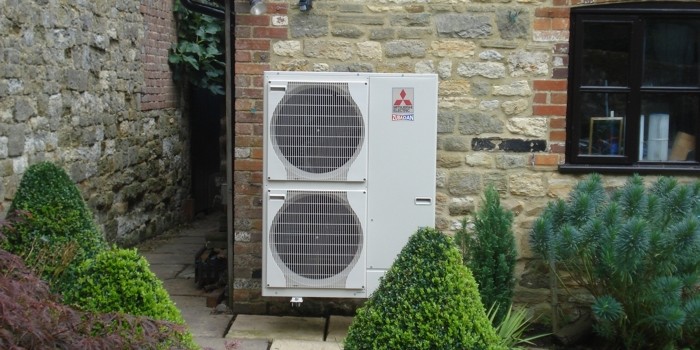
Rural homeowners often have the advantage of space, a garden big enough for a heat pump, a roof all to themselves for solar panels, and fewer neighbours to coordinate with. But don’t be fooled into thinking retrofit is straightforward in the countryside.
Getting tradespeople to rural locations costs more and takes longer. If something needs a return visit (and in retrofit, something usually does), those travel costs add up quickly. Older rural properties ( think solid stone walls, single glazing, thatched roofs or listed building status) can be genuinely tricky to retrofit without specialist knowledge and materials. Cavity wall insulation isn’t even an option for many solid-walled rural homes, meaning external or internal wall insulation becomes the route instead, both of which require more planning and budget.
There’s also the question of grid reliability. If you live somewhere prone to power cuts, you might be understandably wary of systems that depend entirely on a stable electricity supply. These are legitimate concerns and any retrofit plan worth its salt should take them seriously.
Planning rules and ecological surveys can also throw up surprises in rural areas. Protected species, heritage designations and conservation area restrictions can all affect what you’re allowed to do and when, which is why it pays to identify these issues early rather than halfway through a project.
Practical Tips, Wherever You Live
Regardless of whether you’re in a city flat or a country cottage, there are some principles that hold true everywhere when it comes to improving your home’s energy efficiency and reducing your carbon footprint.
Start with your EPC: Your Energy Performance Certificate gives you a snapshot of how energy efficient your home currently is and flags the improvements most likely to make a difference. If you don’t have an up-to-date one, it’s a sensible first step and many lenders and grant schemes will ask for it anyway.
Get a proper assessment: A thorough home assessment (ideally following PAS 2035, the industry standard for retrofit) will flag the specific challenges of your property and location before any work begins. This saves expensive surprises later and ensures the measures installed actually cut your energy bills rather than creating new problems.
Look into government grants early: Schemes like the Warm Homes Plan and the Boiler Upgrade Scheme can significantly reduce the upfront cost of retrofit measures. And it’s not just grants, 0% green financing options are also emerging as a way to spread the cost. Eligibility and availability vary, so it’s worth checking what you can access before committing to a plan.
Think about sequencing: Retrofit measures need to be installed in the right order. Improve your insulation, whether that’s loft, cavity wall or external wall insulation, before upgrading your heating system. Otherwise you’ll be sizing your new heat pump for a leakier home than you’ll actually end up with. Getting the order wrong costs money.
Talk to your neighbours: If you share walls, a roof, or a boundary with someone else, your retrofit project may affect them and theirs may affect you. Early conversations avoid late complications.
It’s Not One-Size-Fits-All
One of the most important things to understand about home energy efficiency is that what works brilliantly for one property can be impractical, or even counterproductive, for another. A solution designed for a Victorian terrace in Leeds won’t necessarily translate to a 1960s bungalow in Cornwall or a purpose-built flat in East London.
The best retrofit programmes group homes by type and location, tailoring their approach rather than applying a blanket solution. It’s more efficient, more cost-effective and leads to better outcomes, lower energy bills, a smaller carbon footprint and a warmer, more comfortable home.
So if you’re thinking about retrofitting your home and taking a step toward net zero, start by embracing the specifics of where you live. Your location isn’t a complication, it’s just part of the picture. And the sooner you understand it, the smoother your retrofit journey will be.
Thinking about retrofitting your home and not sure where to start? Get in touch with the Greenage team, we’re here to help you figure out what works for your property, wherever you are.